
Note: Sustainable practices, including self-sustainability communities, have gained significant attention. This approach provides a holistic means to meet our needs while minimizing environmental impact. Key decision-makers wield significant influence in shaping trends through their “power of choice”.

Indian heritage showcases many examples of collaborative efforts driving economic prosperity. While working on my topic for Lighting for temples, I found a story from our rich heritage content, emphasizing self-reliance, setting a powerful example.
In ancient cultures globally, lamps held deep symbolic importance as the primary source of light, representing belief and devotion. Indian temples, closely linked with lamps, adhered to traditions like perpetual lamps known as “Thoondamani Lamps,” echoing votive lamp customs.
Lighting perpetual lamps in Hindu temples was a significant tradition, akin to practices in other religions. Devotees contributed resources or funds directly to temple management to ensure these lamps remained lit throughout the year. While seemingly simple one-off transactions, King RajaRajaChola of the Imperial Cholas from Tamil Nadu recognized this as an opportunity for societal development when he enhanced a Pandya Regime Scheme.

King Rajaraja Chola introduced a “Immortal Goats” policy. Under this scheme, money given to the temple by devotees for their vows was used to buy goats, which were then given to a needy farmer. In return, the farmer provided a daily unit of ghee(clarified butter) to the temple for lighting the lamp and at the end of the year returned the same number of goats to the temple officer which would be handed over to the next farmer.
In a year, the number of Goats multiplied ensuring the economic prosperity of the needy farmer, the supply of ghee to the temples was ensured without interruption & the same number of goats were handed as an opportunity to the next farmer. This was a win-win situation for the kingdom & an effective way of creating self-sustainable communities. This new plan “ The immortal big goats” of King Raja Raja Chola raised the economical status of the the people without touching the government treasury. An approach & a sense of collaborative economy was experimented thousand of years ago.
In what could be a simple two-way transaction, your vision & choice can simulate an possibility benefiting multiple stakeholders in the end boosting local economy. Hence the decision-maker holds this key “power of choice” that can set new trends.
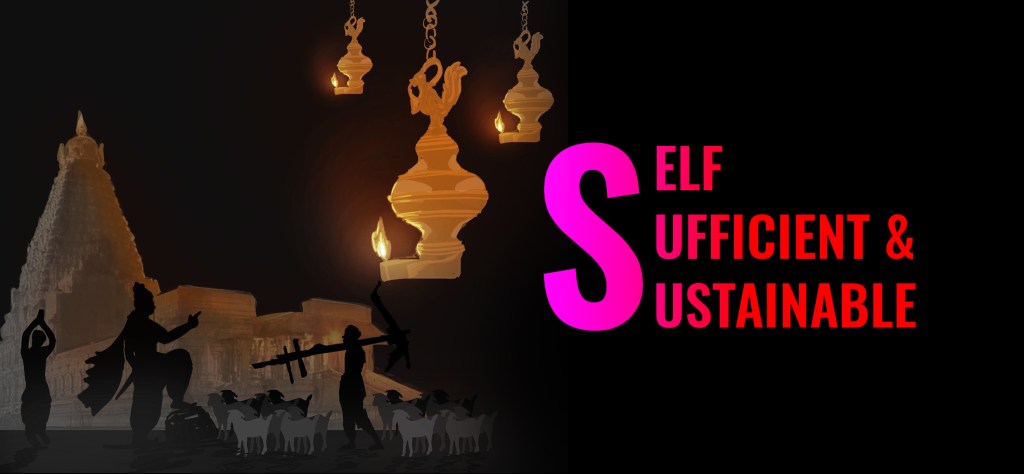
In modern world, energy is an important resource for the survival & development of Human Society. Lighting has evolved beyond simple surface illumination. Despite the efficiency of current light sources, there’s a rising demand for effective lighting solutions to monitor consumption. Our adoption of Circular Lighting represents a crucial stride towards recyclability akin to “the immortal policy,” yet its implementation requires enhancement. Presently, it remains a one-off transaction, but more could be a done to explore collaborative endeavors to ensure its success.
Moreover, while Circular Lighting is pivotal, other urgent aspects of sustainability, such as responsible energy usage and the adoption of renewable energy generation, will be paramount. The objective of fostering a self-reliant community isn’t to achieve complete independence or isolation, but rather it is a first step towards sustainable goals. It also has positive economic impacts.
As I pen down this blog, the Indian government has introduced the PM Suryodaya Yojana aimed at increasing rooftop solar capacity. This scheme empowers individuals to generate energy, utilize it for personal consumption, and potentially sell surplus energy back to the grid. While it undoubtedly presents its own array of challenges, could this initiative mark the initial stride towards fostering self-reliant communities that champion sustainability?
Resulting in a collaborative economy, Could it be regarded as a significant decision? Only time will unveil the answers. What would be your take or approach to handle this more efficiently… let me know in the comments.
 SPACE LUMENS : LIGHTING DESIGN CONSULTANCY
Leave a comment